If you feel bloated before your period every month, and no one has ever explained why, you are not imagining it. Your gut and your hormones are in constant conversation, and when one is struggling, the other very often follows.
As a nutrition therapist, this is one of the most common patterns I see in women who come to me feeling dismissed or told that their symptoms are just something to live with. The good news is that the science behind this connection is now well established, and it points to some genuinely practical things you can do to feel better.

Meet your oestrobolome
Inside your large intestine lives a community of trillions of bacteria, collectively known as your gut microbiome. A specific group of these bacteria has a very particular job: managing your oestrogen. Researchers have given this group its own name, the oestrobolome, defined as the collection of bacterial genes that metabolise oestrogen.
Here is why that matters. Once your body has used oestrogen, your liver packages it up in an inactive form and sends it to your gut to be removed. In an ideal world, it leaves the body in your stool and that is the end of it.
But certain gut bacteria produce an enzyme called beta glucuronidase, which can unlock that packaged oestrogen and switch it back into its active form. Once reactivated, it is reabsorbed into your bloodstream rather than being escorted out.
A little of this is completely normal and healthy. The problem arises when the balance tips. When you have an overgrowth of beta glucuronidase producing bacteria, more oestrogen gets recycled back into circulation than your body intended. Over time, this can contribute to the kind of oestrogen excess that tends to show up as a cluster of familiar symptoms:
Heavy or painful periods
Worsening PMS and mood changes in the second half of the cycle
Breast tenderness
That all too familiar bloating
Why bloating gets worse before your period
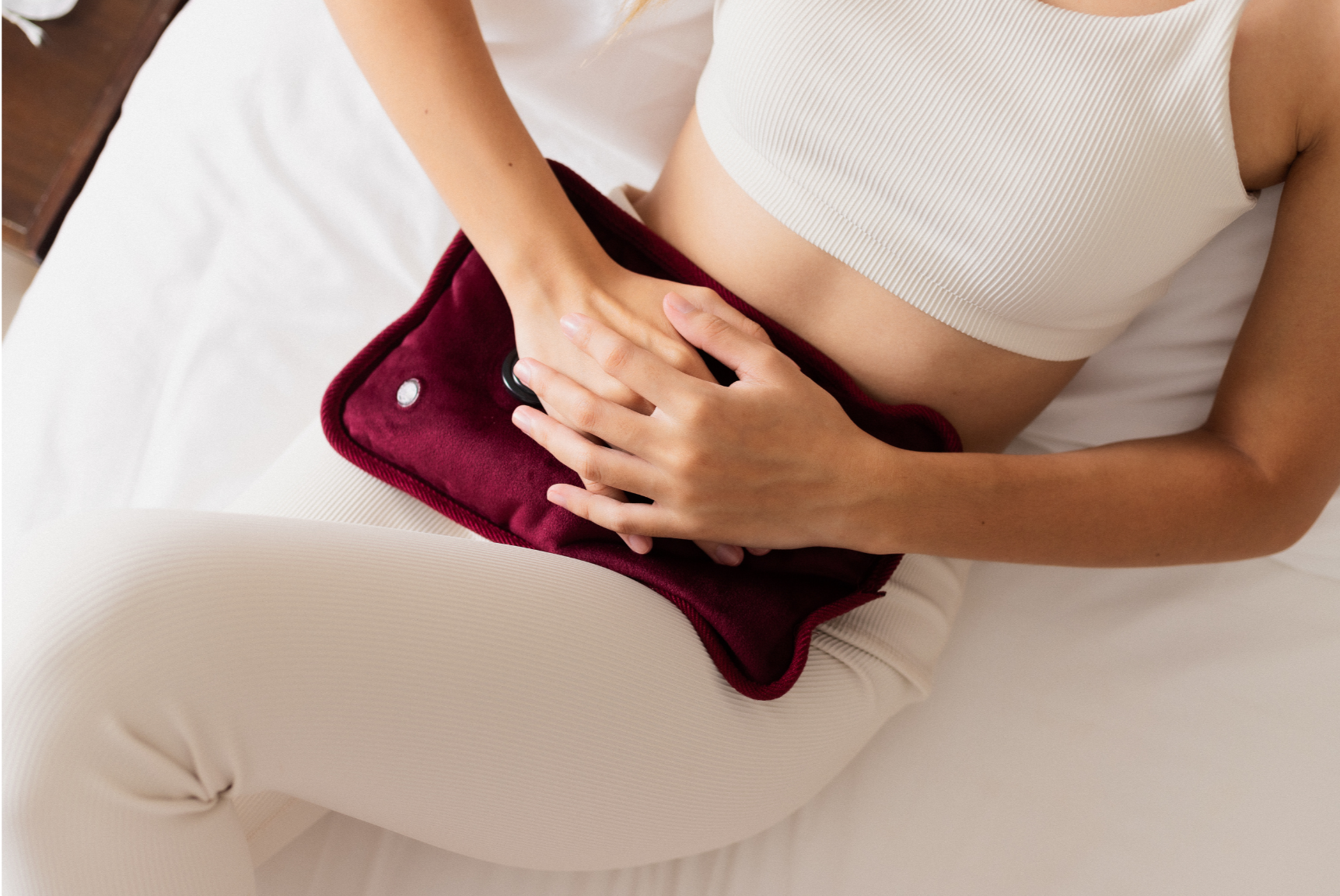
This is where your cycle comes in, and it is the part that explains why the bloating arrives almost like clockwork.
Progesterone rises in the second half of your cycle, the stretch between ovulation and your period. Progesterone relaxes smooth muscle, and your gut is made of smooth muscle. Research measuring gut transit across the menstrual cycle has confirmed that things slow down significantly in this phase compared with the first half.
When digestion slows, food sits in your gut for longer and has more time to ferment. Fermentation produces gas, and gas is a big part of what you feel as bloating. Fluid retention plays a role too, but the gut side of the picture is the half that rarely gets explained.
There is a second consequence, and it gets very little attention. If oestrogen leaves the body in your stool, then anything that slows things down gives that oestrogen more time to be reabsorbed before it can exit.
So a loop forms, and it is one many women are in without realising. Progesterone slows your digestion. Slower digestion means more oestrogen is recycled back into circulation. More circulating oestrogen worsens the bloating, the breast tenderness and the PMS. Then the next month it happens again.
Breaking this loop is often where the most noticeable improvements come from.
When it is not just your cycle: perimenopause, endometriosis and PCOS
The oestrobolome is a two way street. Just as too much beta glucuronidase activity can raise oestrogen, an imbalanced or depleted microbiome can disrupt oestrogen metabolism in less predictable ways.
This matters most during times of natural hormonal change. Studies have found that the menopause transition is associated with a measurable shift in the gut microbiome and oestrobolome, which may partly explain why so many women notice their digestion changing right alongside their hormones during perimenopause and beyond.
It is also why conditions with a strong hormonal component, including endometriosis and polycystic ovary syndrome, are increasingly being studied through the lens of the gut. Researchers have consistently observed patterns of gut imbalance in women with these conditions.
The relationship appears to run in both directions, with hormones shaping the gut and the gut shaping hormones. That is exactly why supporting one so often helps the other.
What actually helps: fibre first
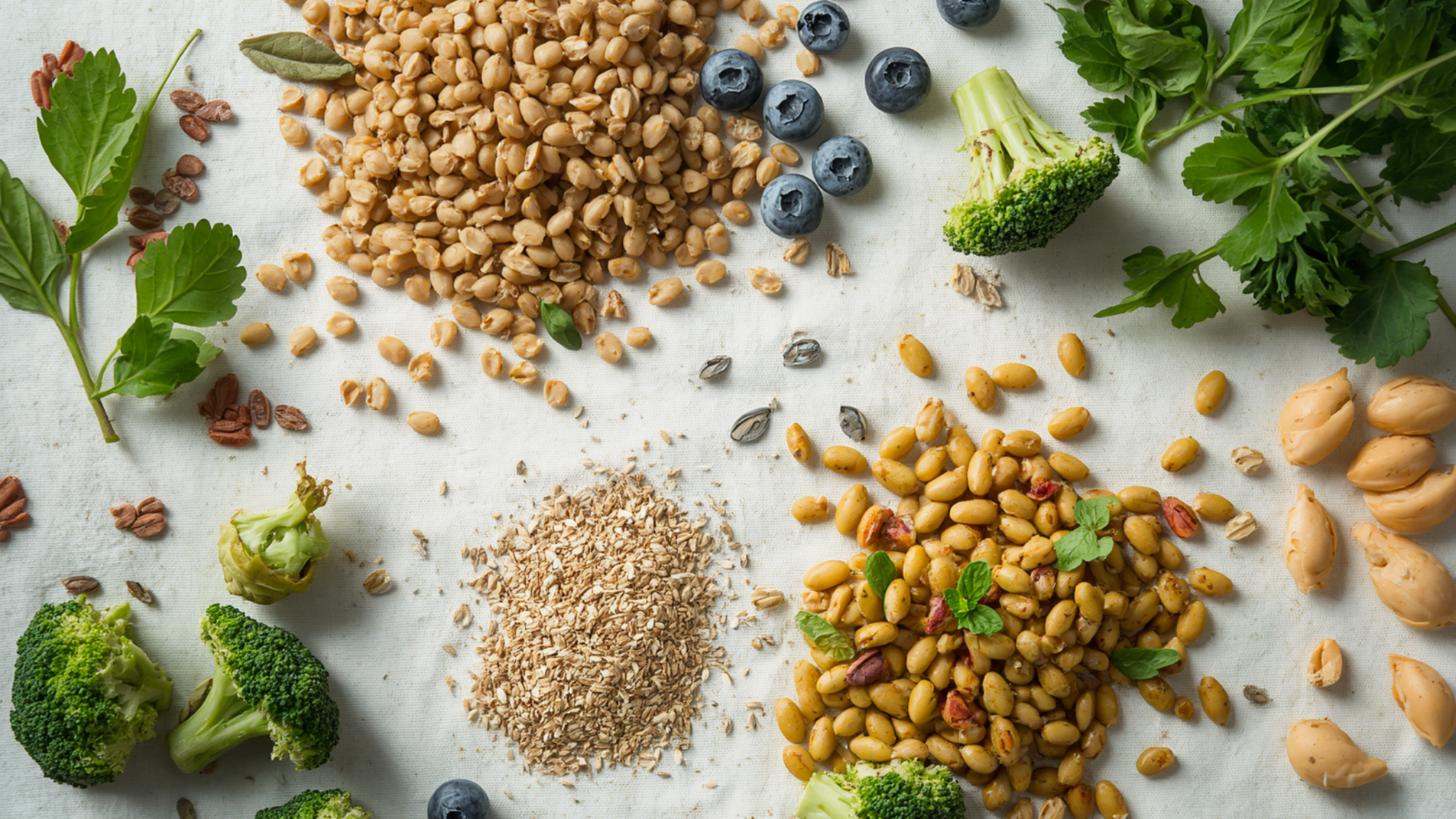
If there is one nutrition change with the strongest evidence behind it, it is eating more fibre. Fibre supports hormone balance through two routes at once.
First, it physically binds to oestrogen in the gut and carries it out of the body in the stool, increasing how much you excrete. Second, higher fibre intakes are associated with lower beta glucuronidase activity, meaning less of that used oestrogen gets reactivated and recycled.
Research on daily fibre intake in menstruating women has linked higher intakes with lower circulating oestrogen, and the effect appears to be driven by fibre itself rather than other parts of the diet.
Most women eat nowhere near enough. A realistic target is around 25 to 30 grams a day, but the way you get there matters. Jumping straight from a low fibre diet to a high one usually backfires with more bloating, not less. I always guide clients to increase gradually, by roughly 5 grams every week or two, and to drink more water alongside it so the extra fibre can do its job comfortably.
A few of my favourite fibre additions for hormone support:
Ground flaxseed: A tablespoon of ground flaxseed added to porridge, yoghurt or a smoothie. Flaxseed is particularly useful here because it provides both fibre and lignans, plant compounds that gently support oestrogen balance.
Pulses: Lentils, chickpeas and beans are among the most fibre dense foods available, and they feed the beneficial bacteria that keep your oestrobolome in balance.
A wide range of plants: Aim for a genuine variety across the week rather than the same few. Different plants feed different bacteria, and diversity is what a resilient microbiome thrives on.
Soluble fibre stars: Berries, pears, oats, chia seeds and cooked and cooled potatoes all provide the soluble fibre that supports regular, comfortable digestion.
Beyond fibre
Fibre is the foundation, but it works best as part of a bigger picture. When I build a plan with a client, I am usually weaving together a few threads at once, because no single food or supplement works in isolation:
Your gut bacteria: looking after the bacteria themselves, so the oestrobolome stays in balance
Blood sugar: keeping it steady, so your hormones are not pushed around by energy crashes
Stress: it has a direct line to both gut function and hormone production
Clearing waste: making sure you are actually going regularly, so oestrogen leaves the body rather than being reabsorbed
The takeaway
Your bloating and your cycle really can be linked, and that is not a frustrating coincidence. It is a sign that your gut and your hormones are working as the connected system they are meant to be. When you understand that connection, the path forward becomes far less overwhelming. Small, consistent changes to how you eat and live can ripple across both systems at once.
If you recognise yourself in any of this, and you are tired of being told it is just your hormones or just your gut, this is exactly the kind of root cause work I do with women every day. You can book a free 20 minute call with me to talk through what is going on and whether working together could help. I would love to hear your story.
Book your free 20 minute call here: www.georginanicolenutrition.com/book
References
Brooks, J.D. Ward, W.E. Lewis, J.E. et al. (2004). 'Supplementation with flaxseed alters estrogen metabolism in postmenopausal women to a greater extent than does supplementation with an equal amount of soy', American Journal of Clinical Nutrition, 79(2), pp.318–325. Available at: https://doi.org/10.1093/ajcn/79.2.318.
Gaskins, A.J. Mumford, S.L. Zhang, C. et al. (2009). 'Effect of daily fiber intake on reproductive function: the BioCycle Study', American Journal of Clinical Nutrition, 90(4), pp.1061–1069. Available at: https://doi.org/10.3945/ajcn.2009.27990.
Hu, S. Ding, Q. Zhang, W. et al. (2023). 'Gut microbial beta-glucuronidase: a vital regulator in female estrogen metabolism', Gut Microbes, 15(1), 2236749. Available at: https://doi.org/10.1080/19490976.2023.2236749.
Kumari, N. Kumari, R. Dua, A. et al. (2024). 'From Gut to Hormones: Unraveling the Role of Gut Microbiota in (Phyto)Estrogen Modulation in Health and Disease', Molecular Nutrition and Food Research, 68(6), e2300688. Available at: https://doi.org/10.1002/mnfr.202300688.
Larnder, A.H. Manges, A.R. and Murphy, R.A. (2025). 'The estrobolome: Estrogen-metabolizing pathways of the gut microbiome and their relation to breast cancer', International Journal of Cancer, 157(4), pp.599–613. Available at: https://doi.org/10.1002/ijc.35427.
McDonald, D. Hyde, E. Debelius, J.W. et al. (2018). 'American Gut: an Open Platform for Citizen Science Microbiome Research', mSystems, 3(3), e00031–18. Available at: https://doi.org/10.1128/mSystems.00031-18.
Michnovicz, J.J. and Bradlow, H.L. (1991). 'Altered estrogen metabolism and excretion in humans following consumption of indole-3-carbinol', Nutrition and Cancer, 16(1), pp.59–66. Available at: https://doi.org/10.1080/01635589109514141.
Peters, B.A. Lin, J. Qi, Q. et al. (2022). 'Menopause Is Associated with an Altered Gut Microbiome and Estrobolome, with Implications for Adverse Cardiometabolic Risk in the Hispanic Community Health Study/Study of Latinos', mSystems, 7(3), e0027322. Available at: https://doi.org/10.1128/msystems.00273-22.
Saponara, S. Scicchitano, F. D'Alterio, M.N. et al. (2026). 'Could the estrobolome have a role in endometriosis pathogenesis and infertility? A systematic review', BMC Women's Health, 26(43). Available at: https://doi.org/10.1186/s12905-025-04195-z.
Wald, A. Van Thiel, D.H. Hoechstetter, L. et al. (1981). 'Gastrointestinal transit: the effect of the menstrual cycle', Gastroenterology, 80(6), pp.1497–1500. Available at: https://pubmed.ncbi.nlm.nih.gov/7227774/.